





Finding the right size for a leather jacket is harder than most people think—and at the same time, the most important step in buying one. Because unlike a T-shirt or a hoodie, leather doesn't forgive mistakes: too tight, and the jacket will strain with every movement. Too loose, and the entire look will appear sloppy instead of stylish. Whether you're ordering your first genuine leather jacket online or trying it on in a store, whether you're looking for a men's leather jacket or a women's leather jacket—this guide will show you step-by-step how to find the fit that truly suits you. As manufacturers of leather jackets, we'll also explain how different types of leather stretch over time, how each cut should fit, and what you can do if your favorite piece doesn't quite fit after all.
1. Why the right size is so crucial for leather jackets
A leather jacket isn't a garment you buy "approximately fitting." It's an investment—in style, in quality, and in a material that only gets better with age. But precisely for this reason, the size has to be right from the start.
The reason lies in the material itself. Leather is a natural product: it adapts to the body, gives slightly in certain places, and molds itself into a custom fit over time. This sounds positive at first—and it is, provided the initial size is correct. If you buy a leather jacket that's too big, it will become even looser over time due to natural stretching and lose its silhouette. If you buy it too small, you'll never be able to wear it comfortably, because leather stretches, but not in all directions and not indefinitely.
In addition, a leather jacket fits differently from a textile jacket. The shoulder seams, the sleeve length, the width in the chest area—all of this needs to fit more precisely, because the material is stiffer than cotton or polyester and fit errors become immediately visible. At trueprodigy, we experience this daily: customers who know their measurements and order specifically are significantly more satisfied with their jacket than those who simply choose their "normal size."
That's why it's worth investing five minutes in proper measuring—before you make a decision that will stay with you for years.
2. How to measure yourself correctly: Step-by-step guide
Before you even look at a size chart, you need your own body measurements. A soft tape measure and five minutes are all it takes. It's best to wear only a thin T-shirt—this way you measure close to your body without thick layers of clothing distorting the result. It becomes even more accurate if someone helps you measure.
Chest circumference — the most important measurement: Place the tape measure horizontally around the widest part of your chest, directly under your armpits. Breathe normally and don't pull the tape too tight—it should lie flat without cutting in. For most manufacturers, the chest circumference is the decisive measurement for clothing size.
Waist circumference: Measure the circumference at the narrowest part of your upper body, usually just above the navel. This measurement is particularly important for fitted models like biker jackets or leather blazers—for straight cuts like the blouson, it plays a lesser role.
Shoulder width: Measure from the outer edge of one shoulder to the outer edge of the other—where the shoulder seam of a well-fitting jacket would end. This measurement is crucial because an incorrect shoulder width cannot be corrected by stretching.
Sleeve length: Bend your arm slightly and measure from the outer edge of your shoulder to your wrist. Some manufacturers measure from the neck—pay attention to which method the size chart you're comparing uses.
Back length: Measure from the nape of your neck (the bone you feel when you tilt your head forward) straight down to the desired jacket length. For most models, this is hip height.
Manufacturer's tip: Write down all measurements in centimeters and compare them with the size chart of the respective manufacturer—not with a general clothing size chart. Because measurements vary significantly from brand to brand. At trueprodigy, you'll find the exact measurements for each model directly on the product page.
3. How should a leather jacket fit? The 5 checkpoints
You have your measurements, you've ordered or you're in the store—now comes the moment of truth. A leather jacket needs to fit correctly in five places to look good and feel good. Here's your checklist.
Checkpoint 1 — Shoulders: The shoulder seam must end exactly on your shoulder. Not an inch above, not an inch below. If it sits too far out, the jacket looks like you borrowed it from someone taller. If it sits too far in, the material will strain with every arm movement. The shoulder is the only area that doesn't change with wear—it has to be right from the start.
Checkpoint 2 — Sleeves: The sleeves should reach your wrist when your arms are hanging relaxed. If you stretch your arms forward, they may slide up slightly—that's normal. Sleeves that are too short cannot be corrected, sleeves that are too long can be shortened in an emergency, but that changes the proportions of the model.
Checkpoint 3 — Chest and Torso: Close the zipper completely. You should be able to breathe comfortably and move with the jacket closed, without the material straining. At the same time, no excess fabric should wrinkle. As a rule of thumb: there should be just enough space between the jacket and your body that you can slide a flat hand in between—but no more.
Checkpoint 4 — Length: Most leather jackets end at hip height. This is the universally most flattering length for almost every body type. Shorter models (cropped) emphasize the waist, longer versions like leather coats lengthen the silhouette. It's crucial that the length matches the cut: a biker jacket that reaches mid-thigh is not proportionally correct.
Checkpoint 5 — The movement test: Raise your arms above your head, twist your torso, sit down, bend forward. The jacket should not cut in anywhere or ride up significantly. This test is the most honest indicator of whether the size truly fits—because you wear a leather jacket in everyday life, not in a photo.
In summary: If the shoulders, sleeves, chest, length, and freedom of movement are right, you have found the correct size. If one of these points is missing, try a different size or a different cut—because not every model is made for every body type.
4. Fit according to cut: Biker, Bomber, Blazer & Co.
Not every leather jacket should fit the same—because each cut has its own fit logic. What is considered "too tight" for a biker jacket would be just right for an oversized model. Here's how the most important men's and women's cuts should fit.
Biker jacket: The biker jacket is inherently body-hugging. It should emphasize the silhouette without restricting movement. The asymmetrical zipper should close without pulling, and the lapels should lie flat. If you're between two sizes for a biker jacket, choose the smaller one—the leather will give slightly in the chest area, and the jacket will mold to your personal fit after a few weeks.
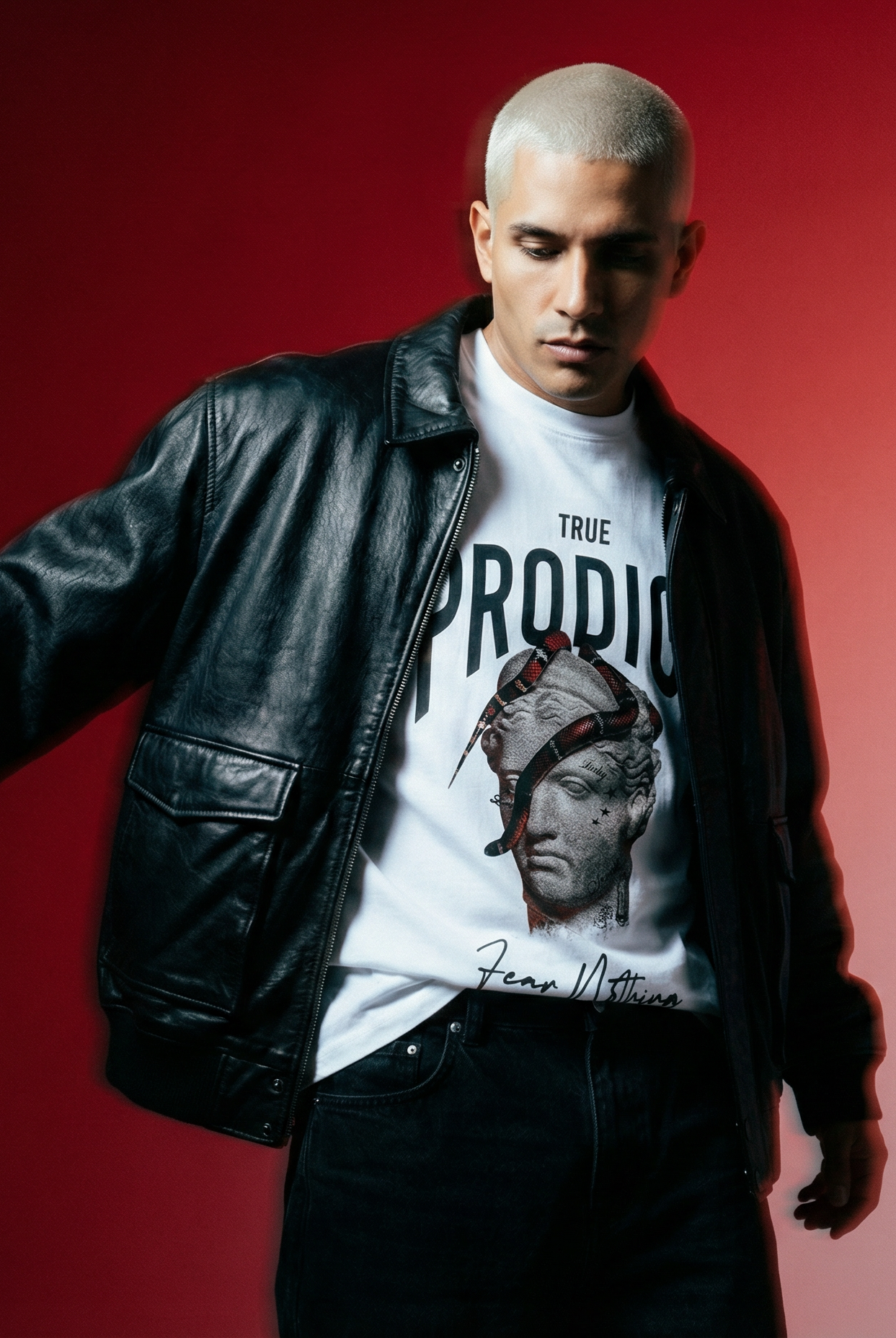
Bomber jacket: The leather bomber jacket fits deliberately looser than a biker jacket. The straight cut with elastic cuffs at the hem and sleeves gives you more freedom of movement. Here, the jacket can fit a little wider without looking sloppy—the cuffs keep everything in place. Choose your regular size.
Leather blazer: The leather blazer follows the fit rules of a classic jacket. The shoulders must fit exactly, the collar must not stick out, and there should be just enough room in the chest area for a shirt or thin sweater underneath. Precision is more important here than with any other model—a blazer that is too large immediately looks shapeless.
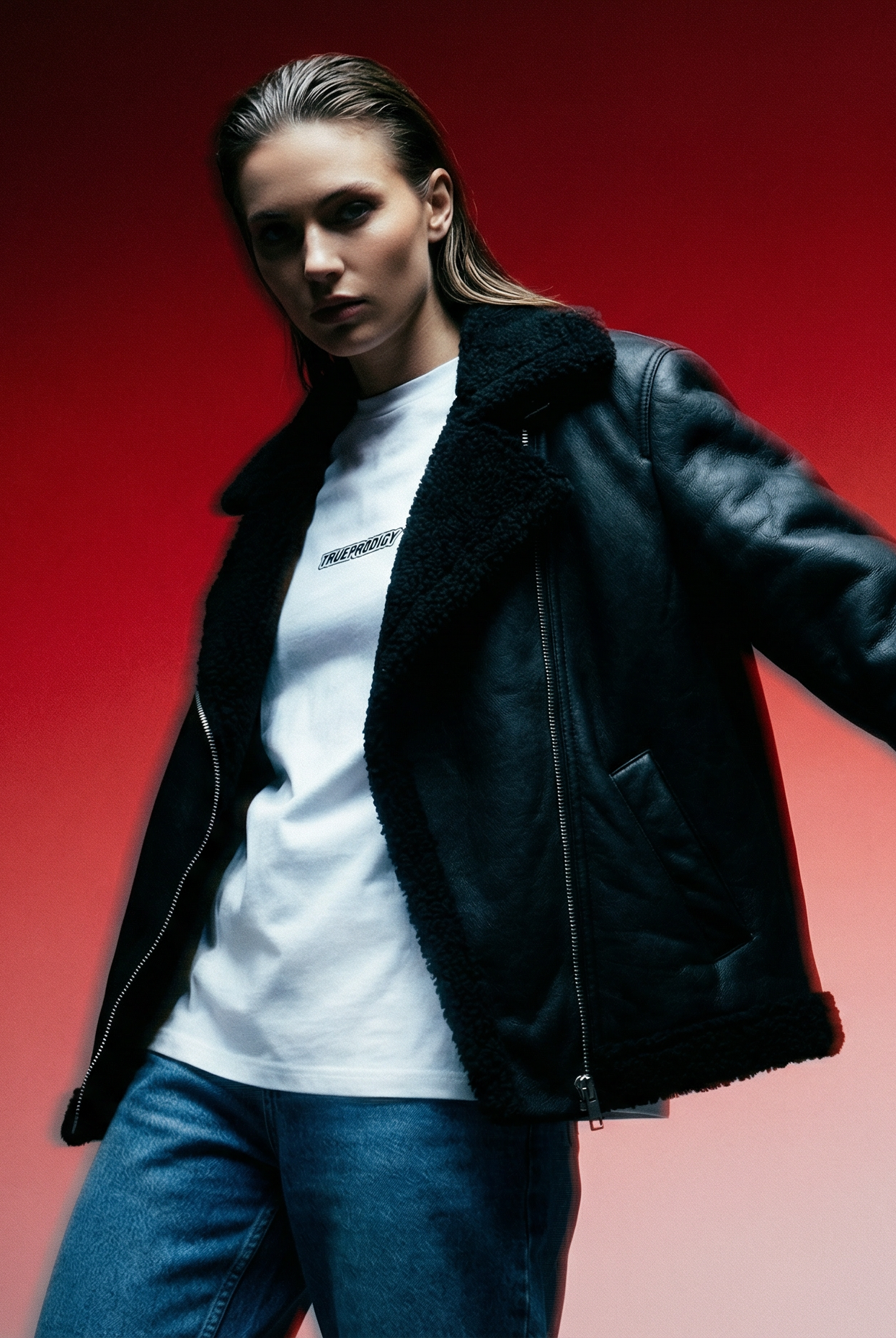
Blouson: The blouson fits between a biker jacket and a bomber jacket: body-hugging, but not tight. The stand-up collar should lie against the neck without pressing, and the concealed zipper should close effortlessly. At trueprodigy, we cut our blousons so that they also fall cleanly over a thicker sweater—an advantage of soft sheepskin over stiff cowhide.
Oversize: With an oversized leather jacket, "too big" is part of the concept—but with limits. The shoulder seam may sit deliberately lower, the sleeves may be longer. But the overall length should not go beyond the hips, and despite the wide cut, the jacket should not look like a sack. Oversize works best if you choose one or a maximum of two sizes above your normal size—no more.
Café Racer: The Café Racer is the slimmest cut among leather jackets. It should fit snugly, emphasize the figure, and have as little excess material as possible. Here's the rule: if you can't decide between two sizes, try both—because with the Café Racer, one centimeter makes the difference between "fits like a glove" and "uncomfortably tight."
If you want to learn about the individual cuts in detail, you'll find a comprehensive overview of all models with styling tips in our men's guide "Men's Leather Jacket 2026".
5. Order larger or smaller? The leather stretch rule
One of the most frequently asked questions when buying a leather jacket is: "Should I order a size larger or smaller?" The answer depends on the material—because not all leather stretches the same.
Basic rule: Real leather will give over time. It adapts to your body, becomes softer in the areas where you move most, and molds into a custom fit. Therefore, if a genuine leather jacket fits slightly snug when you first put it on, that's a good sign. It will become more comfortable in the first two to four weeks of regular wear.
Sheepskin and lamb nappa are the most supple types of leather and stretch the most. If you're wavering between M and L for a sheepskin jacket, choose M. The leather will adapt. This is precisely why we at trueprodigy use sheepskin for most of our models—it offers the best compromise between wearing comfort and fit development.
Goat leather is a bit firmer, but also gives slightly. Here, you can also opt for the smaller size if the difference is small.
Cowhide and calfskin are the stiffest varieties. They stretch less and take longer to adapt to the body. For these types of leather, if in doubt, you should choose the size that already feels comfortable when first worn.
Suede (velour leather) behaves similarly to smooth leather of the same animal species, but is a bit more sensitive due to the roughened surface. It stretches moderately—choose the size that fits well when trying it on, without straining.
Faux leather does not stretch. This is one of the biggest differences from genuine leather and a common reason for mispurchases. If a faux leather jacket feels tight when first worn, it will remain tight. Here you should always choose the size that is immediately comfortable.
In summary: For genuine leather—especially sheepskin and goatskin—it's better to choose the snugger size. For cowhide and faux leather, it's better to choose the more comfortable size. And if in doubt: the manufacturer's size chart is your best friend. If you want to learn more about the different types of leather, you'll find all the details in our guide "How to recognize quality".
6. Women vs. Men: Differences in Fit
Leather jackets for women and men differ not only in design but fundamentally in cut—and thus also in fit. Ignoring this will most likely lead to buying the wrong size.
Shoulder width: Men's models are cut wider in the shoulder area than women's models. This sounds obvious but becomes a problem when women opt for unisex sizes: the shoulder seam often sits too far out, and the entire jacket appears too boxy.
Waist: Women's leather jackets are generally tailored—they taper at the waist and accentuate the figure. Men's models have a straighter cut. If a woman buys a men's jacket, she loses this tailored effect and gets a boxy silhouette.
Hip width: In women's models, the lower hem is often cut a little wider to accommodate the female hip. Men's models are narrower here. This means: a women's leather jacket in size M and a men's leather jacket in size M have completely different measurements despite the same designation.
Sleeve length: Men's sleeves are on average three to five centimeters longer than women's sleeves for the same clothing size. The armhole is also cut wider for men.
What does this mean for you? Always buy the version that is cut for your gender—unless you are consciously looking for an oversized look. In this case, a women's leather jacket can be found in the men's department, but should be chosen at least one size smaller. Discover the suitable models in our women's collection or our men's collection—there you will find the exact measurements for each cut.
7. Buying a leather jacket online: How to find the right size without trying it on
Ordering a leather jacket online feels risky—after all, you can't touch the material or test the fit. But with the right preparation, the risk is minimal. Here are the five steps that will prevent a bad purchase.
Step 1 — Measure yourself: Before you even click "Add to Cart," take five minutes and measure your chest circumference, shoulder width, waist circumference, and sleeve length. Write everything down in centimeters. Without these numbers, any size chart is useless.
Step 2 — Read the manufacturer's size chart: Never rely on your "normal" clothing size. An M at trueprodigy can fit differently than an M at another manufacturer. Compare your measured values with the information in the chart—and use the chest circumference as the guiding measurement.
Step 3 — Check the product description: Good shops specify what type of leather is used (sheepskin, goatskin, cowhide) and whether the cut is rather body-hugging or loose. This information will help you decide whether to order larger or smaller if in doubt.
Step 4 — Read customer reviews: Pay attention to comments on the fit. Phrases like "runs smaller than expected" or "fits exactly as stated" are golden. At trueprodigy, you'll find real customer reviews on each product page that will help you make an assessment.
Step 5 — Use the right of return: Reputable providers offer at least 14 days' right of return, many even 30 days. If in doubt, order two sizes and send back the one that doesn't fit. This is not a sign of uncertainty, but of diligence—especially for an investment like a genuine leather jacket.
Our tip: At trueprodigy, we offer free shipping and returns within Germany, as well as a 30-day right of return. So you can try it on at home, do the movement test, and decide without risk.
8. Leather jacket too tight or too loose? Here's what you can do
Sometimes the size doesn't fit—despite careful measuring. Before you give up on your favorite piece, there are a few options.
If the jacket is too tight:
The first and best option is to wear it. Real leather—especially sheepskin and goatskin—will give in the first few weeks in the areas where it is stressed. Wear the jacket at home over a T-shirt, move around in it, and give the material time. Often two to three weeks are enough for an initially tight jacket to become comfortable.
If that's not enough, a professional leather stretch spray can help. You spray it on the tight spots, wear the jacket wet, and let the leather dry in the desired shape. Important: Test the spray first in an inconspicuous area to avoid stains.
As a last resort, you can take the jacket to a leather tailor. Professional alteration tailors can open seams and widen the model in certain areas—however, this has limits. More than one to two centimeters is generally not possible without destroying the proportions. If you want to learn more about proper care and handling of leather, check out our care guide.
If the jacket is too loose:
This is where it gets more difficult. Making leather tighter is more complex than widening it. A leather tailor can sew the jacket tighter at the side seams, but this changes the cut and is not possible with every model. For a significantly oversized jacket, exchanging it is almost always the better choice.
When is an exchange the right decision? If the shoulders don't fit. The shoulder area cannot be corrected by stretching or altering. If the shoulder seam is wrong, the jacket is simply the wrong size—only a different one will help.
9. Unsure? We'll advise you personally
Size charts and fit tips help immensely—but sometimes uncertainty remains. Perhaps you're precisely between two sizes, unsure about the cut, or ordering your first genuine leather jacket online. That's what we're here for.
At trueprodigy, we offer personal and individual advice via email. Simply email us at info@trueprodigy.de and provide us with the following information:
- Your height
- Your weight
- Chest circumference, waist circumference, and shoulder width (if you have already measured them)
- The model you are interested in
- Whether you prefer to wear the jacket close-fitting or looser
With this information, we can give you a concrete size recommendation — no guesswork, no risk. We know each of our models in detail because we design them ourselves and have them manufactured in our family workshops. This proximity to the product makes all the difference: we don't just recommend a size from a chart, but the size that truly fits your body and your desired look.
You can reach us at info@trueprodigy.de — we usually respond within 24 hours.
Conclusion: Your checklist for the perfect fit
Finding the right size for a leather jacket is not a lottery — if you know what to look for. Here are the most important points again:
- Measure: Always measure your chest circumference, shoulder width, waist circumference, and sleeve length before buying.
- 5 Checkpoints: Shoulders, sleeves, chest, length, and freedom of movement must be right.
- Consider the cut: Each model has its own fit logic — a biker jacket fits differently than a blouson.
- Leather stretch rule: Sheepskin and goatskin stretch — when in doubt, choose the snugger size. For cowhide and faux leather, choose the more comfortable one.
- Women vs. Men: Always buy the gender-specific version, unless an oversized look is desired.
- Online purchase: Compare your own measurements with the manufacturer's chart, read reviews, and use the right of return.
- Personal consultation: Unsure? Email us at info@trueprodigy.de with your height, weight, and measurements — we will help you personally.
At trueprodigy, we manufacture every leather jacket in our family workshops from selected genuine leather — with the aim that it not only looks good but also fits well. Discover the men's collection or the women's collection now and find the model that suits your body and your style. If you want to know how to best combine your new jacket, you can find inspiration in our style guide "Combine Leather Jacket 2026".
FAQ: Frequently Asked Questions about Leather Jacket Size
What size should I choose for a leather jacket?
Measure your chest circumference and compare it with the manufacturer's size chart. Don't rely on your normal clothing size — measurements vary considerably from brand to brand.
Should I choose one size larger or smaller for a leather jacket?
For genuine leather — especially sheepskin — rather the snugger size. The leather will stretch over time. For faux leather, choose the more comfortable size, as it does not stretch.
How tight should a leather jacket fit?
Tight enough that no wrinkles form, but loose enough that you can move freely. When closed, a flat hand should fit between the jacket and your body — but no more.
Do leather jackets get bigger over time?
Yes, genuine leather stretches slightly in areas under strain. Sheepskin stretches the most, cowhide the least. After two to four weeks of regular wear, the jacket will feel noticeably more comfortable.
How should a men's leather jacket fit?
The shoulder seam ends at the shoulder, the sleeves reach the wrist, and the jacket closes at hip height. Nothing should pull when closed. You can find more details in our men's guide "Men's Leather Jacket 2026".
How should a women's leather jacket fit?
Similar basic rules to men's, but women's models are more tailored and wider at the hips. The shoulder seam must fit exactly — never choose men's sizes, unless you deliberately want an oversized look.
What to do if the leather jacket is too tight?
Wear it regularly — genuine leather will stretch. Alternatively, leather stretching spray or a professional leather tailor can help. If the shoulders don't fit, exchanging it is the better option.
Can I buy a leather jacket online without trying it on?
Yes — if you know your measurements and carefully compare them with the manufacturer's size chart. Use the right of return and, if in doubt, order two sizes. At trueprodigy, shipping and returns are free.